


Quick Summary: Manhattan Pedestrian Accident Lawyer
- Most New York pedestrian accident claims have a three-year filing deadline under CPLR 214(5).
- New York’s pure comparative negligence law allows recovery despite partial fault, with damages reduced proportionally.
- No-Fault benefits apply; pain and suffering claims require meeting the serious injury threshold.
- Claims against New York City require a Notice of Claim within 90 days under General Municipal Law 50-e.
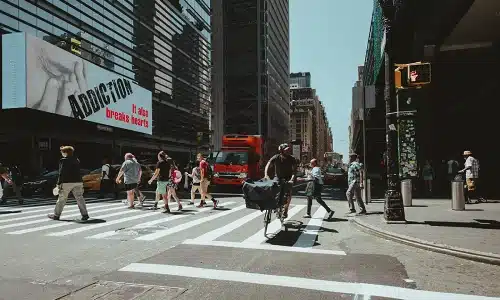 Crossing a Manhattan street can turn dangerous in an instant, especially where heavy foot traffic meets nonstop vehicle traffic. From Times Square and Herald Square to Midtown and the Financial District, pedestrian crashes often occur at busy intersections where drivers fail to yield or become distracted. A pedestrian accident lawyer serving Manhattan can help injured victims understand their legal rights after a collision.
Pedestrian accident claims often depend on timely medical documentation, crash scene evidence, and witness accounts gathered soon after the incident. Acting quickly can help preserve the evidence needed to establish liability and pursue full compensation.
Where Pedestrian Accidents Commonly Happen in Manhattan
Pedestrian crashes rarely happen at random. A few recurring situations account for most of the serious injuries reported across the borough.
Common Pedestrian Accident Scenarios
Most cases fall into a handful of familiar categories.
- Crosswalk collisions. Drivers who fail to yield can strike pedestrians who are lawfully crossing in marked crosswalks, particularly during turning movements.
- Turning-vehicle crashes. Left and right turns at busy intersections create situations where drivers may focus on traffic and fail to notice someone stepping off the curb.
- Vehicle strikes. A pedestrian hit by a car New York drivers, taxis, rideshare vehicles, delivery vans, buses, or trucks can result in catastrophic injuries, with larger commercial vehicles often causing the most severe harm.
- Impaired or distracted driving. Speeding, cellphone use, and impaired driving are recognized risk factors in pedestrian collisions, according to NHTSA pedestrian safety data.
Why These Accidents Often Lead to Serious Injuries
Pedestrians have almost nothing to shield them in a collision, and the same is true for cyclists. Both are highly vulnerable to serious injuries, which is why we also assist clients pursuing a bicycle crash claim after serious injuries. The resulting harm often includes broken bones, head trauma, and permanent impairments that demand long-term care.
Vision Zero in New York City uses engineering, education, and enforcement to reduce traffic crashes and improve safety on New York City streets. These ongoing efforts reflect the serious consequences that pedestrian and bicycle collisions can have, particularly at busy intersections and other high-traffic areas.
Steps That Can Protect Your Pedestrian Accident Claim
What happens in the hours and days after a crash can shape the entire claim. A few deliberate steps help protect both health and any future case.
What to Do Immediately After an Accident
Acting promptly preserves options that are easy to lose.
- Report the collision. Call the police and request assistance so officers can document the scene and create an official accident report.
- Seek immediate medical care. Even injuries that seem minor should be evaluated the same day, since prompt treatment protects both your health and the connection between the injuries and the crash.
- Preserve evidence. Photograph the accident location, traffic signals, and surrounding conditions, collect witness contact information, and keep all medical bills and treatment records.
- Apply for No-Fault benefits on time. A pedestrian struck by a vehicle may access the No-Fault PIP coverage that pedestrian victims receive for medical expenses and a portion of lost earnings. The Personal Injury Protection (PIP) application must generally be filed within 30 days.
Mistakes That Can Make a Claim More Difficult
A few avoidable errors can quietly undercut a strong case. Giving an early recorded statement to an adjuster, letting treatment lapse, or posting about the crash online all hand the insurer material to dispute the injuries. Accepting a quick settlement before the full picture is clear can also leave real costs unpaid.
New York Laws That Affect Pedestrian Accident Claims
A handful of New York rules quietly shape how pedestrian accident claims in Manhattan move forward, from strict filing deadlines to the way shared fault is treated.
Understanding No-Fault Benefits and Your Right to Sue
A pedestrian struck by a motor vehicle counts as a covered person, so New York’s No-Fault insurance benefits pay early medical bills and part of lost wages no matter who caused the crash. This No-Fault PIP coverage that pedestrian claimants receive is first-party protection and does not require proving the driver was negligent.
Suing that driver for pain and suffering is a separate step that depends on meeting the New York serious injury threshold.
Filing Deadlines and Comparative Fault Rules
Most pedestrian claims must be filed within three years of the injury under CPLR 214(5). When the responsible party is a City of New York entity, such as a city bus or a defective sidewalk, a NYC Notice of Claim pedestrian filing is required within 90 days under General Municipal Law 50-e, and missing it can bar the case entirely.
New York also follows pure comparative negligence, so a pedestrian who was partly at fault, perhaps by crossing against a signal, can still recover a reduced amount.
Why Insurance Companies Challenge Pedestrian Accident Claims
Even clear cases meet resistance from insurers. Understanding their playbook makes it easier to respond.
Common Issues During the Claims Process
Carriers commonly dispute who was at fault, how badly the pedestrian was hurt, or whether the treatment was necessary. They may question whether the pedestrian used a crosswalk, obeyed the signal, or somehow contributed to the crash. Each of these arguments is aimed at reducing what the insurer ultimately pays.
How Claims Are Reviewed and Resolved
After liability is investigated, most claims move through a demand letter and settlement negotiation long before any courtroom. If the driver who caused the crash left the scene, recovering from a hit and run may instead depend on the pedestrian’s own uninsured motorist coverage. When talks stall, filing a lawsuit becomes the way to press for a fair result.
Evidence That Can Strengthen a Pedestrian Accident Case
Cases are won on proof, not assertions. The strongest claims rest on evidence gathered early and kept intact.
Records That Help Support Your Claim
In crosswalk accident injury claims, the record usually starts with the police report, nearby surveillance video, scene photographs, and statements from eyewitnesses. Medical records that connect each injury to the collision can also carry significant weight during settlement negotiations or at trial, especially when they document the nature of the injuries and the treatment received.
The New York State Department of Motor Vehicles explains how to obtain an official crash report, including when reports become available, how to order them online, and other request options. Securing a copy of the report early can help preserve important details about the collision while supporting the overall claim.
Why Early Documentation Matters
Evidence disappears quickly, as video is overwritten and memories fade within days. Consistent treatment records show that the injuries were real and continuous rather than exaggerated. Documenting the scene and the damage thoroughly gives the claim a foundation that is hard to dispute.
How a Pedestrian Accident Can Affect Your Future
Serious injuries rarely stay in the past. Their financial and personal weight can stretch for years.
Financial Losses That May Be Recoverable
A serious pedestrian injury piles up costs quickly, from emergency treatment and rehabilitation to future medical care. Beyond medical bills, pedestrian accident compensation New York claims often include lost wages recovery and reduced earning capacity when injuries keep someone from working.
Lasting Effects of a Serious Pedestrian Injury
The heaviest losses are not always financial, and New York allows recovery for non-economic damages such as pain, permanent impairment, and the loss of everyday enjoyment. In rare cases involving especially reckless or intentional conduct, punitive damages may also be available.
What to Expect as Your Claim Moves Forward
Every claim follows its own path, but the broad shape is predictable. Knowing what lies ahead makes the process less daunting.
Situations That May Require Additional Guidance
Some claims are straightforward, while others involve disputed fault, severe injuries, or tangled insurance questions. Cases that require extensive investigation or careful preservation of evidence tend to benefit most from professional help. Working with attorneys who handle pedestrian cases can help a client weigh the real strength of a claim.
From Investigation Through Resolution
The work usually begins by evaluating liability and assembling the supporting documentation. From there, it moves into negotiation with the insurer and, when necessary, preparation for litigation. Should the case reach court, Manhattan pedestrian lawsuits are generally heard in Supreme Court, New York County, while claims up to $50,000 may proceed in the Civil Court of the City of New York.
Local Legal Representation in Manhattan & the Corridors Serving It
Pedestrian accidents in Manhattan can happen at busy intersections, commercial districts, highway approaches, and areas where heavy vehicle and foot traffic overlap. The CEO Lawyer Personal Injury Law Firm represents injured pedestrians throughout New York County and pursues claims involving negligent drivers, commercial vehicles, and other responsible parties when appropriate.
We assist clients with pedestrian accident claims involving locations such as:
- Times Square, Herald Square, and Midtown corridors. Failure-to-yield crashes, turning-vehicle strikes, and crosswalk collisions in some of Manhattan’s busiest pedestrian areas.
- Columbus Circle, Financial District, Chelsea, and SoHo intersections. Intersection and mid-block crashes where heavy foot traffic, deliveries, and vehicle congestion can create increased risks.
- Canal Street and 125th Street corridors. Pedestrian strikes involving passenger vehicles, delivery trucks, and commercial traffic along major crosstown routes.
- FDR Drive and West Side Highway approaches. Ramp-area and highway-adjacent pedestrian crashes where high-speed traffic meets limited walking infrastructure.
Proudly Serving Our Neighboring Communities
Whether you were struck in Times Square, Canal Street, 125th Street, or another Manhattan neighborhood including the Financial District, Chelsea, Midtown, Upper East Side, Upper West Side, Harlem, or Washington Heights, we represent pedestrian accident victims throughout New York County.
We work to gather available evidence, request relevant records when available, evaluate the circumstances surrounding the crash, and pursue claims through the appropriate court when warranted.
Manhattan Pedestrian Accident FAQ
A few questions come up again and again after a pedestrian crash.
How long do I have to file a pedestrian accident claim after being hit by a vehicle in Manhattan?
In most cases, New York allows three years from the date of the injury to file a pedestrian accident lawsuit. That window is much shorter when a city vehicle or a defective sidewalk is involved, because a Notice of Claim is due within 90 days. Confirming the right deadline early keeps the claim alive.
Can I still recover compensation if I was jaywalking or crossing against the traffic signal?
Often, yes. New York’s comparative negligence rule lets an injured pedestrian recover even after sharing some blame, such as by crossing mid-block or against a light. The recovery is reduced by the pedestrian’s percentage of fault, but partial fault does not bar a claim.
What is New York’s serious injury threshold, and how does it affect a pedestrian accident claim?
The New York serious injury threshold, defined in Insurance Law 5102(d), controls when a pedestrian can sue a driver for pain and suffering. Qualifying categories include a bone fracture, significant disfigurement, permanent or significant limitation of a body function, and an injury that prevents normal daily activities for at least 90 of the 180 days after the crash.
Detailed medical documentation, especially in the first weeks, is what proves an injury meets one of these categories.
How a Pedestrian Accident Law Firm Serving Manhattan Can Help
Pedestrian accident claims can involve questions about No-Fault benefits, liability, and the evidence needed to evaluate how New York law applies to a particular incident. Reviewing these issues can help clarify what legal options may be available based on the circumstances of the collision.
Every pedestrian accident presents unique legal and factual considerations. Our legal team serving Manhattan can explain the filing deadlines, insurance rules, and documentation that may affect your case while discussing the legal options that may be available under New York law.