


Quick Summary: Staten Island Construction Accident Lawyer
- Most New York construction accident claims have a three-year filing deadline under CPLR 214(5).
- Labor Law 240(1) imposes strict liability for gravity-related hazards, regardless of worker comparative negligence.
- Injured workers may pursue workers’ compensation benefits and third-party claims against non-employer defendants simultaneously.
- Construction accident lawsuits in Richmond County are generally filed in Supreme Court, Richmond County, St. George.
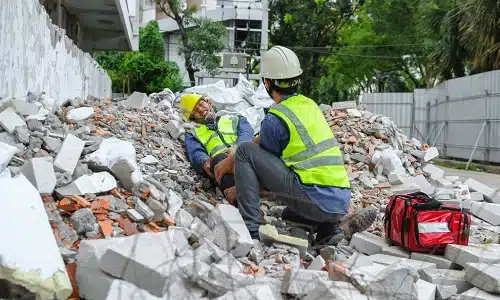 Construction sites across Staten Island expose workers to serious hazards every day. From bridge projects and roadway work to residential and commercial developments, a single safety failure can result in life-changing injuries requiring treatment at the Staten Island University Hospital trauma center. A construction accident lawyer serving Staten Island can help workers understand their legal options after a job-site injury.
Claims involving construction site fall injuries and other workplace accidents may involve workers’ compensation, third-party liability, or both. Understanding injured construction worker rights and preserving evidence early can make a significant difference in the outcome of a claim.
When a Construction Accident Causes Serious Injury
Height, heavy machinery, and crews that change weekly make a job site unlike any other injury setting. Most workplace injury claims in Staten Island that reach a courtroom begin with a hazard somebody was required to guard against.
Construction Accidents That Commonly Lead to Claims
A short list of incidents recurs across residential builds, roadwork zones, and bridge projects.
- Scaffold and ladder falls. Missing guardrails, unsecured planks, and unguarded floor openings account for most scaffold accident injuries. Height turns an ordinary slip into a catastrophic one.
- Struck-by and crane incidents. Tools dropped from upper levels cause severe head trauma, so traumatic brain injury claims often overlap with job-site files. Swinging loads and equipment blind spots create the same danger at ground level.
- Trench collapses and excavation failures. Unshored walls fail without warning, and burial injuries are often fatal. Soil conditions and shoring decisions become the central questions afterward.
- Electrical contact and equipment failures. Live lines, ungrounded tools, and circuits nobody locked out injure workers who cannot see the hazard. Defective machinery can add a manufacturer to the defendants.
Why Construction Accident Cases Are Often More Complex
One site can host an owner, a general contractor, and half a dozen subcontractors, each carrying separate insurance and safety duties. Responsibility routinely reaches past the injured worker’s employer, and New York labor statutes supply protections ordinary negligence law does not.
What to Do After a Construction Accident
Two tracks open at once after a job-site injury: a benefits claim and a possible lawsuit. Choices made in the first weeks affect both.
Steps That Can Help Protect Your Claim
- Report the incident. Notify your employer through the required channels and make sure the accident is documented. A timely report creates an early record of what happened.
- Get medical evaluation. Seek treatment the same day and follow the recommended care plan without gaps. Consistent medical records help document the injury and recovery process.
- Preserve evidence. Photograph the equipment if it is safe to do so and collect the names of coworkers who witnessed the incident. These details may help establish how the injury occurred.
- Track your losses. Keep records of missed work, medical expenses, and other out-of-pocket costs. Organized documentation makes it easier to show the impact of the injury.
Mistakes That Can Weaken Your Case
A handful of habits reliably shrink the value of an otherwise strong file.
- Speaking to an insurer before you know your options. Recorded statements taken within days lock in guesses about the accident. Those guesses become the defense theory.
- Letting treatment lapse. A month without appointments reads as a month without symptoms. Continuity of care is what makes an injury provable.
- Describing the accident on social media. Investigators capture posts, photos, and friends’ comments. Context rarely survives that process.
- Signing an early release. Offers that arrive before a surgical opinion tend to undercount future care. Once signed, the claim closes permanently.
New York Laws That May Affect Your Case
New York extends construction workers protections found nowhere else in the country. Three sections of the Labor Law do most of that work.
Labor Laws That May Apply to Your Case
Labor Law 240(1) places strict liability on owners and general contractors for gravity-related hazards such as falls and falling objects, which is what sets New York Labor Law 240 claims apart from ordinary negligence suits.
Labor Law 241(6) violations instead turn on specific Industrial Code regulations rather than general carelessness. Section 200 covers the broader duty to keep a work area reasonably safe.
Other Legal Rules That May Affect Recovery
Most injury lawsuits must begin within three years of the accident under CPLR 214(5), while city-controlled sites require a Notice of Claim within 90 days. Pure comparative negligence under CPLR 1411 trims an award by the worker’s share of fault instead of erasing it.
Because workers’ compensation exclusive remedy rules bar suing your own employer, Staten Island workers’ compensation claims and a suit against other companies move forward side by side.
Determining Who May Be Responsible
Sorting out defendants is the real work in a job-site file. Contracts, daily logs, and site reports usually settle it.
Parties That May Share Liability
Property owner liability can attach under the Labor Law even when the owner never visited the site, and general contractor negligence covers failures of supervision. Subcontractors that created the hazard, manufacturers of defective machinery, and design professionals may all end up as defendants.
How Insurance Companies Evaluate Construction Claims
Carriers open with the incident report, the written safety program, and any citations for construction site safety violations. They then test whether the facts fit the Labor Law or only ordinary negligence, since third-party construction claims carry greater exposure. Coverage disputes among insurers on the same project can stall a file for months.
Building a Strong Construction Accident Claim
Job sites do not stay still. What gets preserved in the first weeks tends to decide the outcome.
Evidence That Can Strengthen Your Case
Four categories of proof carry the most weight.
- OSHA inspection findings. OSHA construction safety standards help identify workplace hazards. Inspection findings may help document unsafe jobsite conditions.
- Site photographs and incident reports. Images taken before cleanup capture the guardrail that was never installed. Internal reports show what supervisors wrote down that day.
- Coworker statements. Crews scatter to new projects, so accounts grow harder to collect monthly. Early statements preserve detail memory will not.
- Medical and employment records. Imaging, operative notes, and payroll history tie the injury to lost earning power. Consistency matters more than quantity.
Why Early Investigation Matters
Scaffolds come down, trenches get backfilled, and damaged equipment leaves the property within days. Once a site moves on, proving the condition that caused an injury rests on what someone recorded at the time.
Compensation After a Construction Accident
Construction accident compensation reflects documented losses, the policies available, and how permanently an injury limits the work someone can do. Figures vary widely, and no responsible assessment arrives before the medical picture stabilizes.
Financial Losses That May Be Recoverable
Economic damages cover treatment received and care still expected, wages lost during recovery, and diminished earning capacity when a trade is no longer possible. Rehabilitation, assistive equipment, and attendant care belong in the same calculation.
How Serious Injuries Can Affect Daily Life
Non-economic damages account for pain, permanent physical limits, and the activities a worker can no longer share with family. Punitive damages stay rare and require conduct well beyond ordinary carelessness.
What to Expect as Your Case Moves Forward
Civil suits arising from borough job sites may be filed in Richmond County Supreme Court at 26 Central Avenue in St. George, while claims under $50,000 may be heard in the Civil Court of the City of New York. Under New York’s court system, the Supreme Court hears higher-value civil matters beyond the jurisdiction of the lower courts, with appeals proceeding to the Appellate Division, Second Department.
Situations That May Require Additional Legal Review
Serious construction site fall injuries with several contractors on site, disputed coverage, and New York Labor Law 240 claims all call for early review. Catastrophic harm and lifelong care needs raise the stakes on every later decision.
From Investigation Through Resolution
Work opens with site records, contracts, and the statutes that apply, then moves to identifying every insurer with exposure. Negotiation follows once treatment plateaus, and litigation proceeds when the numbers stay far apart.
Local Legal Representation in Staten Island & the Neighborhoods Serving It
Construction accident claims in Staten Island often involve workers’ compensation benefits and third-party claims against property owners, contractors, or other responsible parties under New York Labor Law. At the CEO Lawyer Personal Injury Law Firm, we represent injured construction workers throughout Richmond County and pursue every available source of compensation.
We handle construction accidents throughout Staten Island, including:
- Highway and expressway work zones. Heavy-equipment accidents, struck-by incidents, and work-zone crashes along the Staten Island Expressway (I-278), West Shore Expressway (NY 440), and Korean War Veterans Parkway.
- Residential and commercial construction sites. Scaffold falls, ladder accidents, falling-object injuries, and crane incidents throughout Tottenville, Great Kills, New Dorp, and New Springville.
- St. George and Staten Island Mall developments. Trench collapses, electrical injuries, demolition accidents, and other serious construction-site incidents at commercial projects.
- Bridge and infrastructure projects. Construction injuries involving the Goethals Bridge, Bayonne Bridge, Outerbridge Crossing, and other transportation infrastructure projects.
Proudly Serving Our Neighboring Communities
Whether you were injured on a Staten Island Expressway project, at a construction site in St. George, or elsewhere in Tottenville, Great Kills, New Dorp, New Springville, Port Richmond, Stapleton, West Brighton, Mariners Harbor, or another Staten Island neighborhood, we represent construction accident victims throughout Richmond County.
We move quickly to preserve site evidence, OSHA records, contractor safety documentation, witness statements, and other critical records while pursuing claims against every responsible party.
Staten Island Construction Accident FAQ
Three questions dominate almost every first conversation with an injured tradesperson.
How long do I have to file a construction accident claim in New York after an injury on a Staten Island job site?
Three years from the date of the accident under CPLR 214(5) for most injury lawsuits. Sites owned or controlled by the City of New York require a Notice of Claim within 90 days and suit within one year and 90 days, and a workers’ compensation filing follows its own schedule.
Port Authority bridge projects carry different notice rules again.
Can I pursue a lawsuit against a property owner or general contractor if I am already receiving workers compensation benefits for my construction injury?
Usually, yes. Workers’ compensation benefits come from your employer’s coverage, while third-party construction claims may proceed against owners, contractors, or other parties that were not your employer. Understanding the difference between personal injury vs. workers’ comp claims early can help avoid costly missteps.
The New York State Workers’ Compensation Board provides information and resources related to workers’ compensation benefits.
What does New York Labor Law 240 (the Scaffold Law) cover, and how does it protect injured construction workers?
It reaches elevation-related risks: falls from height and objects falling onto workers below. Scaffold Law liability is strict, so an owner or general contractor can be held liable for failing to supply proper protection even without personal fault, and a worker’s own carelessness is generally no defense.
That standard is why these claims carry weight ordinary negligence claims do not.
A Construction Accident Law Firm Serving Staten Island Can Help You Review Options
Construction accident claims often involve reviewing job site records, contracts, safety reports, and other documentation to determine how the incident occurred and which legal protections may apply. Understanding these details can help clarify the rights and options available under New York law.
The CEO Lawyer Personal Injury Law Firm serving Staten Island provides legal help by reviewing the circumstances of your construction accident, explaining the legal considerations that may affect your claim, including the rights of injured construction workers, and discussing the legal options that may be available based on your situation.