



Quick Summary: Knoxville Premises Liability Lawyer
- Tennessee imposes a one-year statute of limitations on most premises liability claims under Tenn. Code Ann. § 28-3-104(a)(1).
- An injured Knoxville resident recovers only if he is less than 50% at fault; at 50% or more, recovery is barred entirely.
- Non-economic damages are generally capped at $750,000.
- Photographing the hazardous condition immediately and reporting the incident to management creates essential documentation.
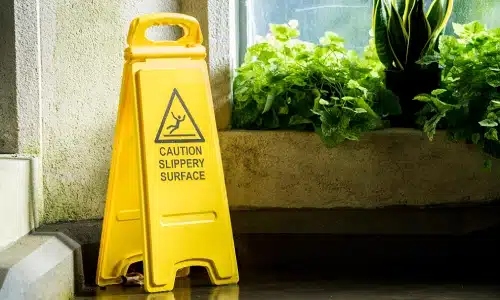 Many hazardous conditions exist in public buildings and often go unnoticed until someone falls. Many falls cause long-term disability to the victim, requiring a considerable amount of time to heal. A slip on a wet floor, a fall down a broken staircase, or even a simple trip over an unlit hallway or parking garage column can cause long-term injury.
Property owners in Knoxville must keep their premises safe for visitors. This includes grocery stores on Kingston Pike; shops and restaurants at West Town Mall and Turkey Creek; bars and music venues in the Old City and Market Square; and apartment complexes near the University of Tennessee with many students. If a property owner ignores a safety issue and someone gets injured, Tennessee law allows the injured person to seek compensation for their injuries.
Knoxville injury lawyer Natori Arrindell represents clients who have suffered injuries on premises across Eastern Tennessee. She can guide clients through a slip-and-fall claim from the initial incident report to filing a lawsuit in the Knox County Circuit Court.
Common Premises Liability Scenarios in Knoxville
Cases involving injuries caused by unsafe conditions on someone else’s property can include more than just a slip on a wet floor. Such an injury can support a claim.
Slip and Fall Accidents in Stores and Restaurants
Many slip and fall cases stem from drink spills and leaks from sources like freezer cases. Some cases also involve floors that were recently mopped without warning signs for shoppers. A Knoxville slip and fall lawyer will usually look at whether the business knew about the hazard or should have found it through routine inspections.
Trip Hazards on Commercial Sidewalks
Many of the premises liability cases CEO Lawyer handles for clients in Knoxville and other parts of East Tennessee involve trip hazards on sidewalks leading to commercial properties, such as cracks in sidewalks and uneven surfaces where buildings connect to the ground, worn and curled-up matting at store entrances, and piles of merchandise that have been left in aisles.
Parking Structures and Poor Lighting
Burned-out lights, unmarked curb edges, and potholes in a parking space or garages can lead to falls that may result in injury.
Negligent Security at Apartment Complexes
Broken entry gates, faulty locks, and a known history of premises liability incident on the property can make a landlord responsible when a tenant or guest is attacked. Additionally, the inadequate security claims may also arise here, considering whether the injury could have been avoided if earlier incidents were properly addressed.
Swimming Pools, Dog Bites, and Elevator Injuries
Swimming pool accidents can involve broken or collapsing pool fences, clogged drain covers that pull people under, or slick deck surfaces around pools.
On one hand, dog bite incidents on someone’s property are governed by Tennessee’s dog bite statute provided under Tenn. Code Ann. § 44-8-413. In such incidents, liability often turns on where the bite occurred (the statute treats bites on the owner’s residential property differently), and whether the owner knew or should have known the dog was dangerous.
While elevator accidents can occur by chance, many result from owners failing to carry out required and necessary maintenance and/or disregarding the results of required and necessary inspections.
What to Do After a Premises Injury
Remember, evidence can be destroyed in minutes, since a spill can be cleaned up within minutes. So, here are the things to do right after a premises injury:
- Get medical care: Visit an emergency room or urgent care, such as the University of Tennessee Medical Center or Fort Sanders Regional, even if the injury seems minor. Head and back injuries can worsen over several days.
- Photograph the hazard: Take pictures of the hazardous condition from several angles. Include pictures of lighting, signs, and shoes that were worn by the victim.
- Report the incident: Tell a manager or property owner what happened and ask for a copy of the incident report.
- Collect witness information: Names and phone numbers of people who saw the fall or noticed the hazard earlier are valuable.
- Keep your shoes and clothing: Store your shoes and clothing as they are, as the insurer will try to blame your footwear for your injury.
- Be careful with adjusters: Be on guard around the adjusters for the owner’s insurance company. They will likely want a recorded statement from you and it is wise to tell them you will get back to them after you have been advised as to your rights.
How Tennessee Law Shapes a Premises Liability Claim
Any premises liability lawyer Knoxville residents speak with will start with three questions: When did the injury happen, who was at fault, and why was the injured person on the property? Each answer ties directly to Tennessee law.
The One-Year Statute of Limitations
Under Tenn. Code Ann. § 28-3-104, most personal injury lawsuits must be filed within one year of the injury. Missing it usually ends the claim, regardless of its strength. However, injuries on public property follow different rules and deadlines. Like for instance, a fall at a city or county building generally falls under the Governmental Tort Liability Act. The said Act carries a 12-month filing period as stated under Tenn. Code Ann. § 29-20-305.
Modified Comparative Fault
Tennessee is a modified comparative fault state – McIntyre v. Balentine, 833 S.W.2d 52 (Tenn. 1992). The injured party must be less than 50% at fault at trial to recover any damages. The fault of the injured party will be used to reduce the award of damages found by the jury.
For example, a plaintiff 20% at fault for failing to watch where he was walking to work could recover 80% of his claimed damages. However, a plaintiff found 50% or more at fault receives no compensation for his injuries.
Visitor Status and the Duty of Care
Traditional common law divided visitors into three groups. Invitees, such as shoppers and restaurant customers, were owed the highest duty. Licensees, such as social guests, were owed a duty to warn of known dangers. Trespassers were owed only protection from willful or wanton conduct.
Under Hudson v. Gaitan, 675 S.W.2d 699 (Tenn. 1984), Tennessee abandoned the distinction between invitees and licensees. Property owners now owe a duty of reasonable care to all lawful visitors, whether they entered on an express or implied invitation. Trespassers remain subject to a more limited duty. A visitor’s status matters because it determines which standard applies, and insurers often contest it first in Knoxville property owner negligence claims.
Proving the Owner Knew About the Hazard
To hold a property owner liable, an injured person generally must show that the owner created the dangerous condition or had actual or constructive notice of it. Constructive notice means the condition existed long enough that a reasonable owner would have found it.
In a case that arose right here, Blair v. West Town Mall, 130 S.W.3d 761 (Tenn. 2004), the Tennessee Supreme Court held that constructive notice can also be shown through a pattern of conduct, a recurring incident, or a general or continuing condition. That ruling helps when a store has a history of the same recurring spill.
How Property Insurers Handle Premises Claims
Insurance companies begin investigating when someone gets hurt on a property. While gathering pertinent information, including proof, the insurance company may argue that the claimant’s injury was their fault because they failed to notice something obvious. The company may also argue that the claimant was partially at fault for their own injuries. Tennessee has a one-year statute of limitations for personal injury claims.
Thus, for example, even though an injured party is entitled to compensation for their injury by property, if a reasonable settlement cannot be reached within one year of the date of injury, the injured person’s only alternative to forgoing compensation is to file suit before the deadline to preserve the claim of compensation for their injury would be to file suit to preserve their right to receive compensation for their injury by property.
Evidence That Strengthens a Premises Liability Claim
Strong evidence answers the “you should have seen it” defense. A Knoxville slip and fall attorney typically moves quickly to secure the following documents and records:
- Incident reports: Secure an incident report because it shows what really happened on the day of the injury.
- Surveillance footage: Send a preservation letter quickly to secure the surveillance footage.
- Maintenance and inspection logs: Secure the maintenance data logs because it will show if the property owner maintained a safe environment for tenants like you.
- Prior complaint records: Look if there are prior complaints about the same hazard or incident as these can establish liability.
- Medical documentation: Any medical records and documentation linking each injury to the incident.
- Witness statements: One of the best evidence is often provided by the Knoxville customers and employees who personally saw how the fall accident happened.
The CDC’s injury prevention resources discuss falls as one of the leading causes of injury-related emergency department visits.
Damages in Tennessee Premises Liability Cases
In determining the amount of compensation that will be awarded in a personal injury case, the severity of the injury, the amount of treatment that is needed, and the amount of fault that each party played in the accident are all considered. Tennessee recognizes three broad categories.
Economic Damages
Economic Damages include past and future expenses for medical treatment and therapy, as well as costs for future care, lost wages, and reduced earning capacity. There is no cap on economic damages in Tennessee.
Non-Economic Damages
Pain and suffering, emotional distress, and loss of enjoyment of life fall into this category. Tenn. Code Ann. § 29-39-102 generally caps non-economic damages at $750,000, rising to $1,000,000 for certain catastrophic injuries such as spinal cord damage resulting in paralysis.
Punitive Damages
Punitive damages are awarded in cases of intentional, fraudulent, malicious, or reckless conduct. Awarded upon clear and convincing evidence. Under Tenn. Code Ann. § 29-39-104, they are generally capped at the greater of twice the compensatory damages or $500,000.
How a Knoxville Premises Liability Lawyer Handles Premises Liability Cases
Natori Arrindell is licensed to handle premises liability matters in Tennessee, North Carolina, Arkansas, and the District of Columbia. As a Knoxville premises liability attorney, she is focused on the details that tend to decide these cases such as: notice, visitor status, and the critical evidence.
The CEO Personal Injury Lawyer represents clients in Tennessee from its office in Chattanooga, and our team supports each case from intake through resolution.
Where Does an Attorney File Your Premises Liability Claim
A premises liability lawyer files a claim in Knox County Circuit Court or, for smaller claims, Knox County General Sessions Court. The Tennessee court system overview explains how these courts operate.
Local Legal Representation for Knoxville & Knox County Residents
Most of the incidents occur in locations where Knoxville families and residents frequently go. Typically, by the time one can establish that the property owner had knowledge of the incident, evidence will have disappeared within a day or so.
- Retail stores along Kingston Pike & West Town Mall (37919): Slip and fall cases on beverages, leakage from coolers, and falls on recently mopped floors in which a repeat hazard will establish notice to retailers under the applicable Tennessee case law developed at West Town Mall.
- Student apartments near UT & Fort Sanders (37916): Broken stairs, poor lighting, and negligent security claims involving faulty gates, locks, and a history of prior incidents.
- Market Square & the Old City: Uneven brick, worn entry mats, and dimly lit stairways at various bars, restaurants, and music venues.
- Downtown Garages & City Sidewalks: Trip hazards and unlit parking areas, including falls on public property that follow the separate Governmental Tort Liability Act rules.
Proudly Serving Our Neighboring Communities
Our team works with injured people in Bearden, West Hills, South Knoxville, North Knoxville, Farragut, Halls, and Powell. We also write letters requesting incident reports and maintenance records, and obtain medical records from UT Medical Center and Fort Sanders Regional Health System to prepare claims for trial in the Knox County Circuit Court or the Knox County General Sessions Court.
Knoxville Premises Liability FAQ
How long do I have to file a premises liability claim after being injured on someone’s property in Knoxville?
If you’ve been hurt while visiting someone else’s property in Knoxville, you typically have one year to file a claim for your injuries. This rule is based on Tenn. Code Ann. § 28-3-104.
However, if you were injured on public property, there is a different 12-month deadline, and there are some extra steps you need to follow. It’s important to check the specific deadline for your situation as soon as possible.
Can I still recover compensation if I was partially at fault for my slip and fall injury in Knoxville, Tennessee?
If you had a slip and fall injury in Knoxville, Tennessee, you can still get compensation even if you are partially responsible for the accident, as long as you’re not more than 50% at fault.
If you are less than 50% at fault, any amount you receive will just be reduced based on your level of fault. However, if you are found to be 50% or more at fault, you won’t be able to get any compensation at all.
What must be proven to hold a property owner liable for dangerous conditions in a Knoxville premises liability case?
You generally must show that a dangerous condition existed, that the owner created it or knew or should have known about it, that the owner failed to fix it or warn about it, and that the condition caused your injury. A premises liability attorney Knoxville residents consult can help assess whether the available evidence supports each element.
Speaking With a Knoxville Premises Liability Law Firm
Premises cases in Tennessee move on a short clock, and the evidence that proves notice is often the first to vanish. Understanding visitor status and comparative fault helps an injured person avoid early mistakes.
Natori Arrindell handles premises liability claims for injured residents throughout Knoxville and Knox County, including Bearden, West Hills, South Knoxville, North Knoxville, and Farragut. Speaking with a premises liability attorney serving Knoxville, Tennessee can help you review your options after an injury on someone else’s property.