

 Motorcyclists are consistently overrepresented in traffic fatalities and injuries, usually due to the lack of safety features like seatbelts and airbags on motorcycles.
Most bikers ride carefully and make every effort to minimize the risk of accidents. Unfortunately, you can’t force others to do the same, and a reckless driver can leave you with severe injuries, including:
- Broken bones. Even one relatively minor fracture can cause weeks or months of pain and prevent you from doing your usual activities (including going to work in some cases). In severe accidents, a biker may suffer several broken bones or more complex fractures that take longer to heal.
- Head or traumatic brain injuries (TBI). A collision with a car often results in a motorcyclist being ejected from their bike. When you hit the ground, your head is likely to make contact with the pavement, potentially causing a concussion or a more serious TBI. Although many people make a full recovery after a TBI, some suffer permanent disability or impairment, including difficulties with movement, cognition, speech or language, memory, seizures, or chronic headaches. The most effective way to reduce your risk of a TBI is to always wear a well-fitting, DOT-approved helmet when you ride.
- Facial or eye injuries. It’s not unusual for someone to suffer an eye injury or facial fracture at the same time as a head injury. In severe cases, vision loss may occur, or the rider may need surgery to correct a fracture. A full-face helmet provides the most protection against face and eye injuries.
- Soft tissue injuries. Often, injured people are relieved to learn they don’t have a broken bone, but soft tissue injuries can be just as persistently painful in some cases. If you suffer a torn muscle or ligament or nerve damage, you could develop long-term or chronic pain. Biker’s Arm, sometimes called Rider’s Arm, is one common injury that usually occurs when the bike falls onto the motorcyclist’s arm, causing nerve damage. However, you can suffer soft tissue and nerve injuries anywhere in your body, depending on the details of your accident.
- Back, neck, and spine injuries. Some of the most severe injuries happen when the spine is fractured or damaged, which could cause permanent paralysis. Other back and neck injuries result in chronic pain and may limit your ability to work.
- Road rash. Most motorcyclists are familiar with this painful condition, which happens when contact with the pavement tears or damages the skin. This may sound like a minor laceration to someone who’s never seen or experienced road rash, but some instances of road rash damage or remove multiple layers of skin. Additionally, gravel or other debris can become lodged in the skin, increasing the risk of infection and scarring. More severe cases may require skin grafting or wound debridement, so seeking medical care for these friction burns is always important.
- Internal injuries. Sometimes, the rider is ejected from their bike and hits the ground face-first. Usually, riders will put out their arms to protect themselves, but covering all areas of the torso is impossible. Some experience internal bleeding or bruising and may need surgery.
What Can a Dekalb County Motorcycle Accident Attorney Do to Help?
When you or a loved one has been injured in a motorcycle accident, you may have medical bills, lost income from being out of work, long-term pain, and many other damages. You need financial compensation from the at-fault driver’s car insurance company, but they will work to pay you as little as possible, or even nothing at all.
Your motorcycle accident lawyer will help you with several challenges that motorcycle riders often face when dealing with an accident claim:
- The driver and/or insurance company blame you for the accident. Even if the other driver was cited for an infraction, the insurance company could still say you were partly at fault in an effort to avoid paying your claim or pay you less than your claim is worth. We’ll talk more about shared fault later in this article.
- The insurance company makes you an offer. We know this doesn’t sound like a problem, but in many cases, the insurance carrier’s first offer is a lowball one that doesn’t cover all your damages. This initial offer may seem more than fair because most people don’t know their damages. Unfortunately, some injured bikers realize they have more expenses months later, but the insurance company is no longer obligated to help them. Your lawyer will be sure to correctly calculate all your damages so you can tell if an offer is reasonable.
What Are the Most Common Types of Motorcycle Accidents?
Motorcycle collisions can happen in a wide variety of ways, but here are some scenarios we see most frequently:
Cars Turning in Front of Motorcycles
This is a particularly big problem with left turns but can also happen with right turns, especially at intersections. Sometimes, the vehicle driver is distracted or intoxicated, but in many cases, they obey the law and pay attention, yet they still don’t see the motorcycle.
Bikes are harder to see because of their size, and depending on where the crash happens, there may also be other factors, such as landscape features like trees or buildings that partially block the driver’s view.
Drivers making left turns are encouraged to “look twice and save a life” before turning. It’s also a good idea to turn down the radio and open the windows, making it easier to hear a bike coming even if it isn’t in sight.
Motorcyclists can also help reduce their risk by staying as visible as possible. Consider wearing bright, reflective clothing or adding reflective patches to your motorcycle gear.
Riding with your headlight on at all times is also advisable. Additionally, you should look out for drivers who appear to be inching out of a driveway or intersection and be prepared to stop if they don’t.
When cars turn right in front of a motorcycle, the cause is often running a red light or stop sign. The safest way for motorists to avoid these accidents is to always come to a complete stop at stop signs and red lights and look carefully before turning.
Unfortunately, bikers can’t always rely on vehicle drivers to handle these situations. When riding your motorcycle, keep an eye out for cars that don’t look like they’re slowing or stopping at an intersection, even if you have the right of way.
Lane Switching
Everyone should be careful when changing lanes, but this is an especially tricky maneuver for motorcyclists. Again, the problem is visibility, a bike can easily fit into another driver’s blind spot.
Reflective patches and headlights are less helpful here as the driver’s view is usually blocked by the bulk of their vehicle. The most effective solution is to avoid spending time in a driver’s blind spot as much as possible, if you can’t see the driver or their mirrors, they likely don’t see you.
Before switching lanes, look for signs the vehicle drivers around you are also planning a move:
- The vehicle has a turning signal on. Unfortunately, the lack of a turning signal doesn’t necessarily mean the driver has no plans to move over because sometimes drivers forget.
- The vehicle’s wheels are turning.
- You see the driver turning their head, generally, drivers do this when checking their blind spot before a turn or lane change.
- The driver appears to be checking their mirrors.
Rear-End Accidents
You might think that if someone is tailgating you on your bike, then at least they probably see you. While that may be true, it doesn’t necessarily prevent rear-end accidents.
In these situations, visibility is less likely to be an issue, but speeding and distracted driving are common causes.
In most rear-end crashes, the rear driver is assumed to be at fault, but that won’t stop the insurance company from claiming you were at least partly to blame. As we discussed earlier, this is a common tactic insurance carriers use to reduce an injured person’s payment.
Under Georgia law, fault can be divided between parties in an accident or injury situation. If you are less than 50 percent responsible, you can still collect damages from the other party, but your percentage of fault will reduce your award.
One scenario is that the driver or insurance company comes up with an excuse for why you might share fault with the rear driver. Yes, they were probably going too fast, but the driver may claim your taillight was out and you were hard to see (especially if the weather was foggy).
If the insurance company wants to reduce or deny your claim based on their theories about your role in the accident, your lawyer will fight for you to obtain the full settlement you deserve. We’ll aggressively investigate your accident, collecting evidence to support your claim and creating a strategy to prove your case.
We can usually negotiate a reasonable payout with the insurance company, but if necessary, we’re always prepared to argue your case in court.
Head-On Collisions
These are caused by one of the motorists crossing over into oncoming traffic. Frequently, the driver who swerves over the line is intoxicated or has fallen asleep at the wheel.
In some cases involving motorcycles, the car driver is swerving to avoid an obstruction in the road and may not notice the motorcycle until it’s too late.
To avoid head-on collisions, you must scan the road ahead and look for any sign that oncoming drivers are driving erratically so you can respond by slowing down. Keeping to the right of the road also puts you farther away from vehicles that cross the double-yellow line, on a bike, you can ride to the right side of your lane even if you’re on a two-lane road.
If an oncoming vehicle driver seems to have trouble keeping their car between the lines or is headed your way, you may want to ride off the road momentarily if you can do so safely. If an accident does occur, a personal injury lawyer in Dekalb County can assist you with your claim.
Lane Splitting Accidents
We’ve all been there: You’re sitting in traffic, trapped in a line of cars that seems to be moving at a snail’s pace, wishing there was a faster way to your destination. If you’re on a motorcycle, you may think zipping between the lanes of traffic is a good solution.
Unfortunately, this is also a good way to get in an accident. Vehicle drivers aren’t expecting anyone to be in between the lanes of traffic and may move over without seeing you.
Lane splitting is illegal in Georgia for a reason, and avoiding it is the easiest way to prevent a lane-splitting accident.
How Can You Protect Your Rights After a Motorcycle Accident?
First, get medical attention for your injuries, don’t try to tough it out or assume you will be fine tomorrow. In fact, many people feel worse hours or days after an accident when the adrenaline wears off and the injured area has started to swell.
Seeing a healthcare provider ensures you will be evaluated for potentially serious injuries, such as a TBI, that may not produce symptoms immediately.
When giving the police a statement, you should answer questions honestly, but there is no need to speculate about fault. Keep your answers brief and to the point, and don’t volunteer information you weren’t explicitly asked about.
Call a motorcycle accident lawyer right away. We’ll investigate the crash immediately to build a strong case and negotiate for the largest settlement possible.
We know motorcycle accidents can be costly in terms of money, time, and quality of life, and we want to ensure you receive the compensation you deserve.
How Can You Get Help From a Dekalb County Motorcycle Accident Law Firm?
Please contact the CEO Lawyer Personal Injury Law Firm for a free consultation about your case. We’ll review the evidence, answer your questions, and advise you on your options for recovering damages.
As always, there is no fee until we win or settle your case, so you have nothing to lose.
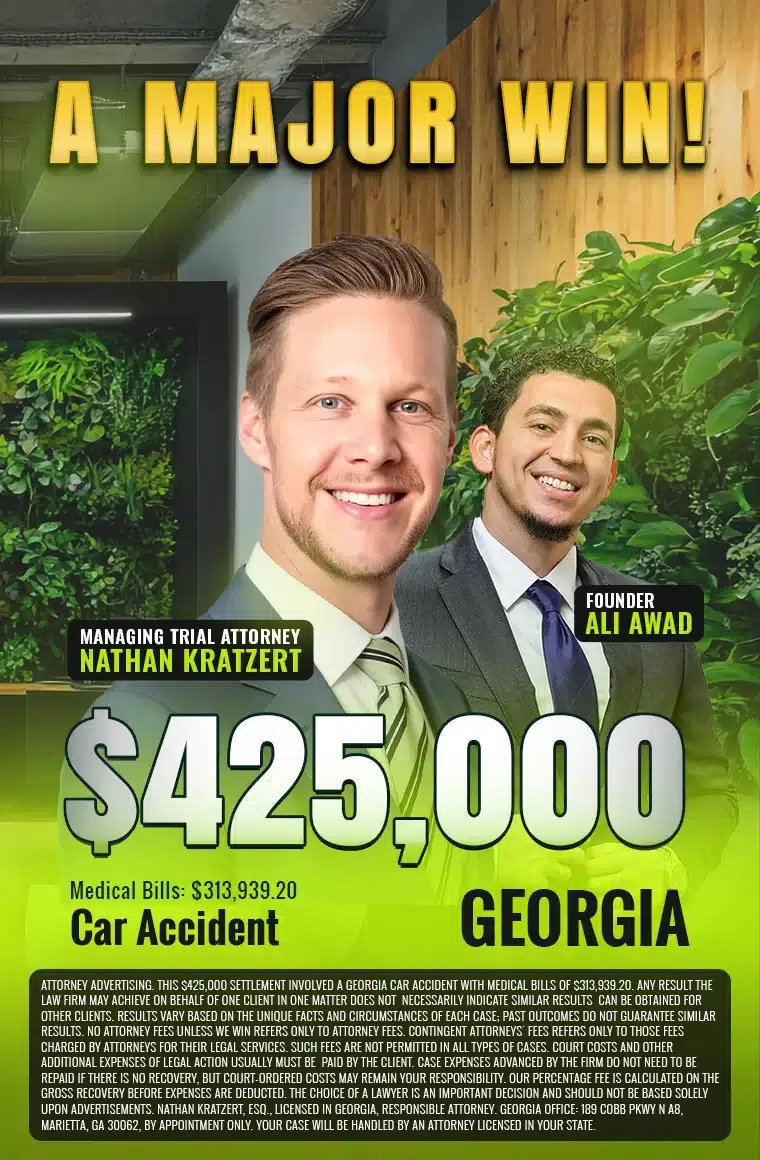
Attorney Ali Awad founded the CEO Lawyer Personal Injury Law Firm and quickly turned it into one of the fastest-growing law firms in the country. He and his team have over twenty years of combined experience and have worked to recover millions of dollars in compensation for their clients.
In his spare time, Mr. Awad posts free legal advice on social media for more than a million followers. Work with The CEO Lawyer today by calling (470) 323-8779.