

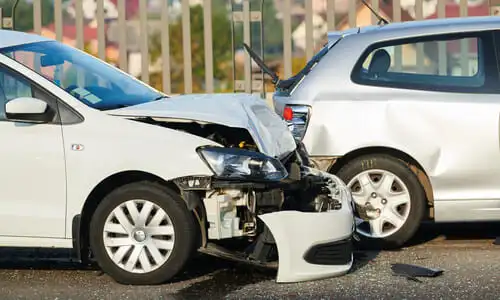
 Despite being known as a golf cart-friendly community, Peachtree City is also home to many cars, and car accidents. Often caused by driver error, car accidents can lead to severe injuries, high medical bills, weeks or months of lost income, car repairs, and more damages.
To make matters worse, the at-fault driver’s insurance adjuster could waste time blaming you for the accident or undervalue your damages. How can you secure the settlement you deserve after a car accident?
Talk to a Peachtree City Car Accident Attorney Today
It’s hard to know if you’re getting a fair deal when the insurance company denies your claim, or makes you a settlement offer. Calculating the value of a claim is a complex process, and there are several factors that can reduce the final settlement.
Additionally, determining fault can be more complicated than you’d expect. For these reasons, we recommend speaking with a seasoned car accident attorney who understands the insurance company’s tactics and will fight to get you the resolution you need.
The CEO Lawyer Personal Injury Law Firm is always available for a free consultation about your car accident case. If you’re worried about recovering damages, unsure if you have a case, or have other questions or concerns, we’ll help you get the answers you need.
There is no obligation, and if we take your case, you won’t owe us anything until we win or settle it.
Car Versus Golf Cart: Who Is at Fault?
We can assist you with any kind of car accident. But in a city with golf carts in over 10,000 households, car/golf cart collisions are more likely. Fortunately, Peachtree City has more than 90 miles of car-free paths designated for golf carts to reduce the risk of these accidents.
Also, golf carts are prohibited on or across Hwy 54, Hwy 74, Peachtree Pkwy, or Crosstown Road due to high speeds and traffic volume. Carts can be driven on roads with lower speed limits, but if a path exists parallel to a road, cart drivers should always use the path.
As a result, accidents involving cars and golf carts most commonly occur at crosswalks or intersections. To reduce these collisions, the city created new legislation in 2020 stating that drivers on recreational paths must come to a complete stop before crossing road intersections.
In these situations, these drivers should then yield to road traffic that’s in the intersection or close enough to pose a hazard.
If a golf cart driver fails to follow these guidelines and collides with a car, they may be at fault. However, vehicle drivers should also exercise caution when approaching intersections and be on the lookout for approaching carts.
When a car hits a golf cart in an intersection or crosswalk, the driver may have been speeding, distracted, or at fault for other reasons. Your attorney can help you determine any potentially liable parties.
Can Both Parties Be at Fault in a Car Accident?
Yes. This is true whether the collision involves two cars, a car and a golf cart, a car and a pedestrian, etc.
Georgia’s modified comparative negligence statutes provide for situations in which both parties have made errors that led to an accident or injury. The party that is less than 50 percent responsible can recover damages from a party that is more than 50 percent responsible.
Note, however, that the injured person’s recovery will be reduced by their own percentage of fault.
As an example, let’s say that a car is approaching an intersection. The driver is exceeding the speed limit and doesn’t see the golf cart entering the intersection.
The car and golf cart collide, and the golf cart driver is injured. When the police arrive, the golf cart driver says they had the right of way because they were already in the intersection when the car entered.
The car driver says they couldn’t see the golf cart because its headlights weren’t on, and it was getting dark.
In this case, both drivers were negligent, the car driver for speeding and the golf cart driver for failing to use their headlights as required by Peachtree City laws. Determining who is more at fault depends on a number of factors, including the car driver’s exact speed, how dark it was, etc.
If you are hit by a car while in a golf cart and the car driver is all or primarily at fault, you can make a claim on their liability insurance as you would in any car accident. However, their insurance adjuster will quickly look for reasons to deny your claim or reduce your settlement.
For this reason, we recommend contacting an attorney as soon as possible so we can investigate your collision, gather evidence, and build a strong case.
Will Your Golf Cart Insurance Cover Your Injuries?
Probably not. Most golf cart insurance policies cover bodily injury liability, which means they cover injuries you cause others.
So, if you run into a pedestrian while driving a golf cart, your insurance should pay for their medical bills and related expenses. Likewise, your insurance will pay for the other party’s property damage if you hit another golf cart.
If you have Comprehensive Coverage and Collision Coverage, damage to your golf cart may also be covered.
However, most golf cart insurance policies are not meant to cover your own injuries in an accident. If you were hurt in a golf cart collision, we recommend consulting a personal injury lawyer in Peachtree City to learn whether another party is liable.
Who Determines Fault in a Car Accident?
Most often, one or more insurance companies decide on the apportionment of fault in a car accident. When both drivers make claims on each other’s policies, the two insurance companies will negotiate with each other, and eventually, the adjusters will reach an agreement.
Unfortunately, both adjusters are focused on saving their own company money, and the injured parties may suffer in this decision. A car accident lawyer will help protect you from the following issues that could cost you:
An Unfair Distribution of Fault
Insurance adjusters should base their decisions about fault on the facts of the case, but there is still room to overestimate or underestimate a driver’s share of responsibility. In some cases, we find the adjuster’s decision embellishes the client’s portion of fault.
Other times, the adjuster may have attributed some fault to a client based on disputed facts. For instance, the other driver might claim our client didn’t use their signal or made some other error, but the client insists they did nothing wrong.
If we can find evidence to show they didn’t contribute to the crash, we can seek to recover all their damages without a deduction for partial responsibility.
Undervaluing Damages
Comparative negligence is not the only basis for an insurance company to reduce a car accident settlement. Sometimes, they undervalue the worth of the client’s damages.
It’s important to understand that there are a number of potential damages in any car accident case, and most people are only familiar with a few of them. Some only file a claim for the bills they’ve received, such as hospital bills and car repair estimates.
They may be unaware they can seek compensation for many other damages, including car rental fees, pain and suffering, out-of-pocket costs for mobility aids or physical therapy equipment, future medical care costs, and more. If the insurance adjuster doesn’t ask about these expenses or work to include them, the injured person could lose thousands of dollars in compensation they deserve.
An adjuster could also undervalue your claim in other ways. With medical claims, they might refuse to pay for one of your treatments, stating it’s unnecessary or unrelated to the car accident.
Frequently, this is an issue if the injured person has a preexisting condition, even though the accident may have worsened this condition or caused new injuries. Or, the insurance adjuster might decide that you should have a less expensive treatment despite your healthcare provider’s recommendations.
In these cases, your attorney will fight to ensure you receive the treatment you need.
Other damages, like pain and suffering, are more difficult to calculate because they aren’t attached to a specific dollar amount on a bill or estimate. Typically, insurance adjusters use formulas to calculate pain and suffering.
One standard formula is the Multiplier Method, in which they assign a number between 1.5 and 5 and then multiply it by the injured party’s economic damages.
There are a variety of factors that can lead to a higher number, including the severity of your injuries, how long it took you to recover, whether you suffered any permanent disability, etc. Even then, adjusters may come up with different numbers, for example, assigning a three instead of a four or a four instead of a five.
If we believe your number is too low, we’ll negotiate with the insurance carrier, reminding them of the severity of your afflictions and providing additional medical documentation if necessary.
What if You Suffer Severe Injuries and the At-Fault Driver’s Insurance Won’t Cover All Your Damages?
In these situations, the issue isn’t necessarily that the insurance company has undervalued your claim or assigned you a percentage of fault. When you have a high-dollar claim, there is also the possibility that your damages exceed the at-fault driver’s policy limit.
In Georgia, the minimum required auto insurance is $25,000 per person for bodily injury liability ($50,000 total) and $25,000 for property damage.
For minor or moderate injuries, this coverage may be sufficient. But if you’ve suffered a severe injury, especially one resulting in a chronic problem or permanent disability or disfigurement, your medical bills and related damages could be six figures or more.
Yet, the insurance company is not obligated to pay anything beyond the $25,000 limit if the other driver bought this minimum coverage. Worse, if there were other people injured in the accident, the $50,000 would be divided between all of you, so you might receive less than $25,000.
These situations can be frustrating, but your lawyer will examine other options for recovering the rest of your damages, including:
- Suing the driver. In some cases, we can recover damages directly from the at-fault driver. However, if the driver has no substantial assets we can seize, this may not be a worthwhile pursuit.
- Turning to your own insurance coverage. If you have uninsured/underinsured motorist coverage (UM/UI), we might be able to recover additional damages up to your own policy limit. This is usually the most dependable option, but unfortunately, not everyone has UM/UI insurance, as it isn’t required in Georgia.
- Suing a third party. This will not apply in every car accident case, but in some situations, a third party may have contributed to the collision. For instance, if a bar or restaurant overserved a customer who was already intoxicated, and they proceeded to drive drunk and cause your accident, it might be possible to pursue a claim against the establishment. It would still be necessary to prove the server knew or should have known the patron was already intoxicated and that they would be driving soon.
Where Can You Turn for Help From a Peachtree City Car Accident Law Firm?
If you or a loved one have been injured in a car accident, please contact the CEO Lawyer Personal Injury Law Firm for a free consultation. We’ll review your case, answer your questions, and discuss the options for pursuing damages.
You don’t have to worry about upfront costs because we never charge any fees until we win or settle your case.
Attorney Ali Awad founded the CEO Lawyer Personal Injury Law Firm, and within a few short years, he turned it into one of the fastest-growing law firms in the country. He and his team have over fifty years of combined experience in personal injury law and have recovered millions of dollars in compensation for clients.
In his spare time, Mr. Awad offers down-to-earth legal advice to more than a million followers on social media.