




 At the end of a long day, it can be tempting to hit the road and tune out, yet disaster waits for no one. In one sudden, heart-pounding moment, you can quickly find your peace of mind shattered when a nearby truck’s cargo spills onto the road, causing chaos and danger all around.
At this moment, you’ve found yourself in what we call an improperly loaded cargo accident.
The screeching of brakes, the blaring of horns, and the adrenaline-fueled rush of fear: it’s an experience no one should ever endure. Yet, these incidents occur, leaving victims grappling with the aftermath of injuries, property damage, and a sense of injustice.
So if you’ve found yourself involved in an accident caused by another driver’s improperly loaded cargo, reach out to our team today. At the CEO Lawyer Personal Injury Law Firm, we can help you navigate the complicated next steps to come, ensuring that you have the highest chances possible that all of your damages are compensated for by the responsible party.
To reach out to our team, simply call (404) 777-8800 or use this link. From there, we can help you schedule a free, confidential case evaluation, with no obligation required.
When Should I Reach Out to an Atlanta Improperly Loaded Cargo Attorney?
After an accident, it can be difficult to tell when you should consider reaching out to a Atlanta personal injury law firm. Often, we may feel tempted to proceed on our own, or we may simply not know how or who to reach out to to speak with an attorney.
So, to make things easier, here are a handful of key indicators that you should consider reaching out to an attorney after an accident caused by another driver’s improperly loaded cargo:
- If You Sustain Injuries: If you’ve sustained injuries you can’t take any chances, and need to reach out to a car accident attorney Your attorney can help you connect with qualified medical care and keep all of your expenses organized and documented, so you can build a strong claim from the very start. Down the line, they can also help you secure compensation for other damages, like pain and suffering or lost wages.
- Complications With Insurance or Liability: If you’re not sure who is liable for the accident, your attorney can conduct their own thorough investigation to help determine who is responsible. Similarly, if you’re experiencing delays or inadequate settlement offers from your insurance company, an attorney can help you cut through the noise to determine whether you may be owed more than they are initially offering.
- A Looming Statute of Limitations: In Georgia, there is a limited timeframe (known as the statute of limitations) within which you must file your personal injury claim. If this deadline is approaching, you should consider consulting an attorney so you can expedite the claims process.
Understanding Improperly Loaded Cargo Accidents
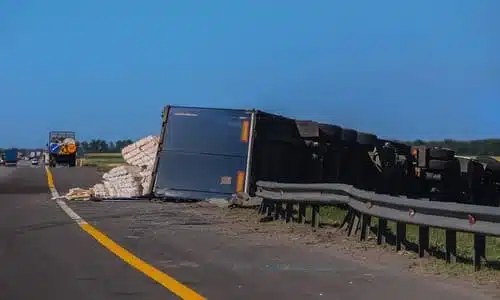 These accidents occur when cargo being transported on a vehicle, typically a large truck or commercial vehicle is not loaded, secured, or balanced correctly. This can lead to a cascade of problems, including cargo shifting during transit, cargo spilling onto the road, or even the vehicle tipping over due to an unbalanced load.
The consequences of improperly loaded cargo accidents can be far-reaching. First and foremost, they pose a significant risk to the safety of everyone on the road.
Cargo that spills onto the highway can create hazardous conditions, leading to additional accidents and injuries. Moreover, these accidents can result in various types of injuries, ranging from minor cuts and bruises to severe injuries or even fatalities.
Occupants of other vehicles involved in the accident, as well as the drivers of the cargo-laden vehicles themselves, can all be at risk. Plus, beyond these immediate safety concerns, improperly loaded cargo accidents can lead to extensive property damage.
Vehicles may be damaged or destroyed, and the cargo itself may be lost or damaged. From there, cleanup and road repair costs can quickly add up.
So, why do these accidents happen? They often occur due to a combination of factors, including inadequate training of truck drivers, rushed loading processes, or negligence on the part of cargo loaders.
Understanding Liability in Improperly Loaded Cargo Accidents
After any accident, it’s important to determine who is to blame so that they can be pursued for damages. That said, in the case of these kinds of incidents, determining liability can be all the more complicated.
For one, there are a wide range of parties that may be held responsible, and tracing the incident back to one make-or-break moment makes things all the more difficult.
For example, any of the following parties might be named ‘liable’ for the accident:
- Drivers: In many cases, the driver of the vehicle carrying the “improperly loaded cargo” may share some degree of responsibility. Drivers are typically expected to ensure that their cargo is secure and balanced before hitting the road. If they fail to do so, or if they ignore signs of shifting cargo during transit, they can be held liable for the resulting accident. Note that employers assume responsibility for the negligent acts of their employee drivers.
- Trucking Companies: Trucking companies also bear a significant responsibility when it comes to cargo safety. They are responsible for training their drivers, ensuring that cargo is loaded and secured properly, and maintaining their fleet’s safety. If a trucking company’s negligence in any of these areas leads to an accident, they can be held liable.
- Shippers and Loaders: Finally, those who were initially responsible for loading the cargo onto the vehicle, often referred to as “shippers or loaders,” are also crucial players in the chain of responsibility. If they load the cargo improperly, exceed weight limits, or fail to secure it adequately, they can be held liable for accidents resulting from their negligence.
To determine liability, you need to establish negligence.
Negligence, in this context, refers to a failure to exercise the care and diligence that a reasonable person or entity is expected to show under similar circumstances. This negligence can manifest in various ways, such as inadequate training, rushed loading processes, or disregard for safety regulations.
Proving negligence will often involve gathering evidence from the accident scene, including photographs, witness statements, and police reports. It will also often entail examining records (like maintenance logs or training records) to determine if any violations or oversights occurred.
To make matters even more complicated, in some situations, multiple parties can also be found to share liability for the incident. In these kinds of situations, you’ll definitely want to let your lawyer handle the next steps, as it would be impossible to hold everyone accountable on your own.
Local Laws and Regulations in Atlanta
When it comes to improperly loaded cargo accidents, there are a handful of local laws, codes, and regulations that your attorney can use to hold the responsible party accountable for their negligence. These laws set the framework for cargo transportation and ultimately aim to keep the city’s roads safe from unnecessary accidents.
One of the most important laws to know in regard to improperly loaded cargo is Georgia Code Section 32-6-1.
Georgia Code Section 32-6-1
This section of Georgia’s legal code sits at the heart of the state’s transportation laws. It addresses various aspects of highways, bridges, and ferries and provides the legal foundation for cargo transportation regulations, as well as outlines several ‘legal limitations.’
Atlanta, like many other regions, imposes specific legal limitations on cargo transportation to ensure safety on its roadways. These limitations include:
- Overall Legal Dimensions: Cargo vehicles must adhere to certain dimensions, including a maximum width of 8 feet and 6 inches, a height limit of 13 feet and 6 inches, a length limit of 100 feet (including overhang), and a gross weight limit of 80,000 pounds. Exceeding these dimensions typically requires a permit.
- Legal Maximum Weight Limitations: Weight limits are critical in cargo transportation. On interstate highway systems, lift axles may not be used in calculating the maximum total gross weight authorized for any vehicle or load. Legal axle weight is set at 20,340 pounds, with tandem axle limits varying based on gross weight and length.
- Federal Bridge Formula: The Federal Bridge Formula is applicable to weight limitations on all roads. It calculates the overall gross weight of groups of consecutive axles based on distance and the number of axles in the group. Understanding this formula is essential for ensuring compliance with weight limits.
- State Route Gross Weight: Different weight limits apply to vehicles based on the number of axles they have. For instance, vehicles with five axles have a maximum gross weight of 80,000 pounds, while those with four axles are limited to 70,000 pounds. The State Bridge Formula further determines weight limits for specific vehicles.
- Non-Interstate Route Exemptions: On non-interstate routes, weight limitations may be exceeded in specific situations. This includes scenarios like hauling forest products, live poultry, or unhardened concrete from plant to customer. Knowing these exemptions can be valuable in understanding your rights and obligations.
Understanding these local laws and regulations is essential when dealing with improperly loaded cargo accidents in Atlanta, but it’s not on you to know them. Instead, this is where your attorney comes in.
Let us do the heavy lifting so we can make sure that you receive compensation for any damages caused by another negligent party.
How to Contact an Atlanta Improperly Loaded Cargo Law Firm
The easiest way to contact an Atlanta Improperly Loaded Cargo Law Firm is simply to reach out to our team here.
At the CEO Personal Injury Law Firm, we’re here to make sure that your rights are protected and your interests advocated for. So call (404) 777-8800 or contact us online to contact our team today to see how we can help you streamline all of the complicated next steps to come, ensuring that you’re maximizing your chances to secure the compensation you’re owed.